Fat loss coaching: how to track client progress beyond body weight
Choose useful indicators, interpret fluctuations and agree on adjustments after checking the context.
Short answer
To follow a fat loss goal, connect comparable observations, reported habits and the client’s experience. Body weight measures total mass rather than body fat directly. Check collection conditions and whether the plan is workable before changing several parameters in response to one fluctuation.
A client wants to lose body fat. After an unusual weekend, their scale reading rises and they ask whether the programme is still working. Answering from that single value can lead a personal trainer to make a premature adjustment. Useful follow-up places the measurement within a trend, the collection conditions and what the client was actually able to do.
This guide explains how to organise coaching follow-up for a fat loss goal. It does not provide a standard diet or a universal target weight. The examples are fictional and focus on the review process, the quality of the available information and the client’s experience of the plan.
Why is body weight insufficient to measure fat loss?
A scale measures total body mass, not body fat directly. Changes can reflect factors such as hydration and digestive contents. An isolated reading therefore cannot establish that the difference comes from losing or gaining fat.
Ask how the measurement was taken and compare observations collected under reasonably consistent conditions. The purpose is not to make the routine obsessive. It is to avoid treating two very different situations as if they measured an identical phenomenon.
The NIDDK describes tracking eating habits, activity and weight as parts of a weight management approach. For coaching, that supports connecting observations instead of making every decision depend on one daily number.
Explain this limit during the initial assessment. Clients should understand what an indicator can show and what it cannot establish. This makes a review calmer when the graph does not move in a perfectly consistent direction from one observation to the next.
A weight change is an observation. “I have lost body fat” is an interpretation that requires more context. The purpose of follow-up is to make that distinction understandable without treating every fluctuation as a problem.
Which indicators should you track with a fat loss client?
Choose a small number of indicators and explain their purpose. You might combine a weight trend, when appropriate for the person, with completed training, feedback about habits and their experience. Sleep, hunger and fatigue can provide context without becoming scores that must always be optimised.
Measurements or photos are options rather than mandatory steps. Discuss their usefulness, comparison conditions and the client’s comfort. A photo does not precisely measure body composition, and changes in lighting or posture can complicate interpretation.
- Observation
- Weight trend
- Possible use
- Place a change across several observations
- Limit to explain
- Does not directly measure body fat
- Observation
- Logged workouts
- Possible use
- Check whether the programme is workable
- Limit to explain
- A missing entry is not always a missed session
- Observation
- Food diary
- Possible use
- Discuss a practical eating habit
- Limit to explain
- Portions and entries remain approximate
- Observation
- Chosen measurement
- Possible use
- Compare a reference under stable conditions
- Limit to explain
- Measurement technique affects the value
- Observation
- Experience and constraints
- Possible use
- Understand what helps or gets in the way
- Limit to explain
- One reply does not describe the whole week
| Observation | Possible use | Limit to explain |
|---|---|---|
| Weight trend | Place a change across several observations | Does not directly measure body fat |
| Logged workouts | Check whether the programme is workable | A missing entry is not always a missed session |
| Food diary | Discuss a practical eating habit | Portions and entries remain approximate |
| Chosen measurement | Compare a reference under stable conditions | Measurement technique affects the value |
| Experience and constraints | Understand what helps or gets in the way | One reply does not describe the whole week |
For broader client management, use the client tracking indicators guide. The priority here is selecting observations that help with this particular goal and are acceptable to this particular person, rather than collecting everything your software could display.
How can you prepare a review without jumping to conclusions?
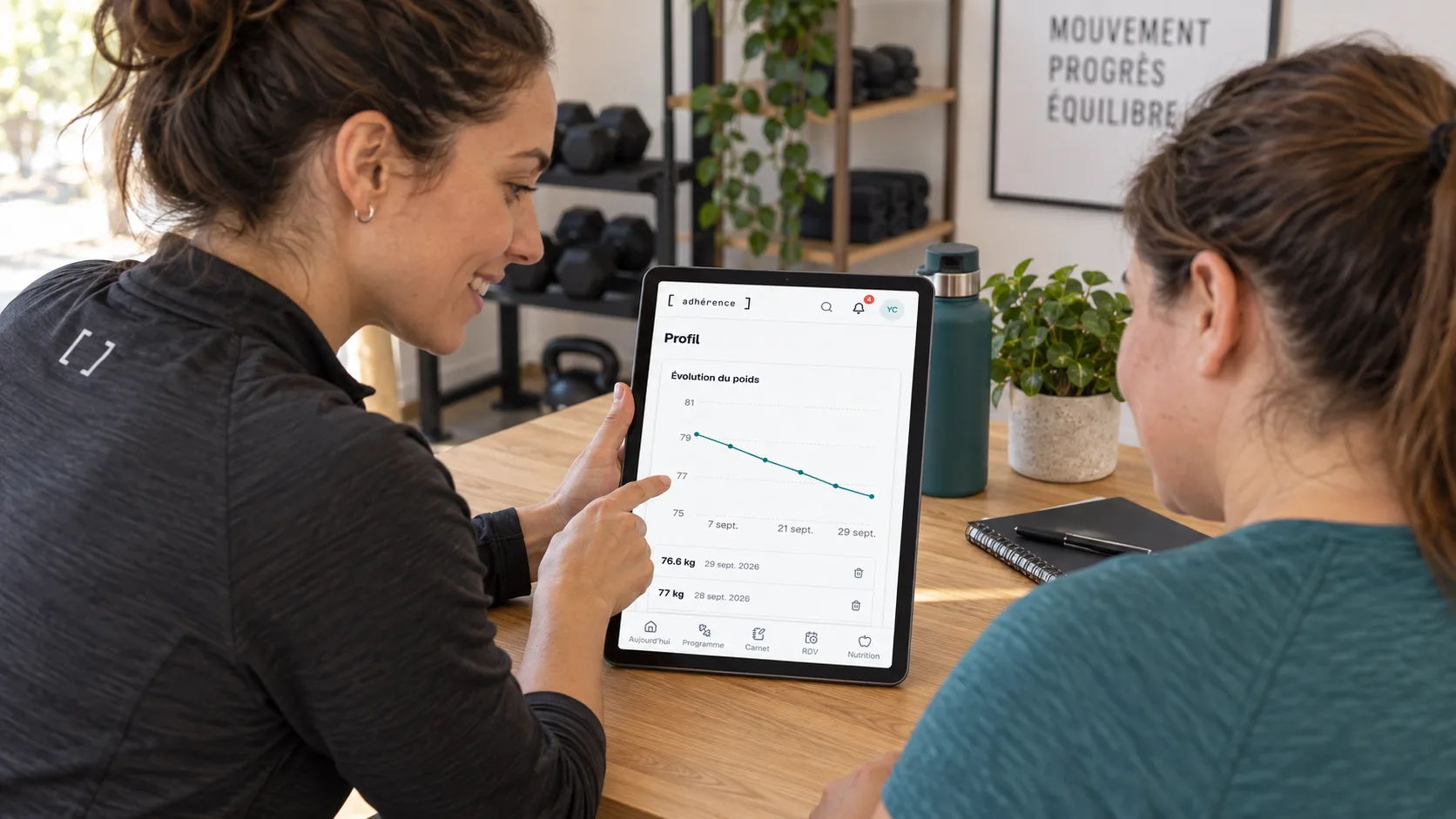
Start by checking the quality of the available information. Are there enough comparable observations? Are some entries missing? Has travel changed the usual circumstances? Uncertain information should first prompt clarification rather than a confident conclusion about progress.
Next, read the activity actually reported. A prescribed programme is different from a completed programme. If the client managed only part of the week, ask what made it difficult before adding another constraint. The obstacle may involve scheduling, equipment or an unclear instruction.
Choose a question that supports action. “Which meal is hardest to organise when you get home late?” is more useful than “were you disciplined this week?”. Your language should open a conversation rather than classify days as moral successes or failures.
In a fictional example, a client has one higher reading after travelling and two unlogged workouts. The coach first checks measurement conditions and whether those sessions happened. They do not automatically reduce food intake based on that combination alone.
What role should a food diary and TDEE calculator play?
A food diary can support discussion about portions, organisation and habits. Its accuracy depends on food entries, quantities and context. A missing entry does not mean the client skipped a meal; a displayed total is not an exact measurement of their actual intake.
If you use the TDEE calculator, present its result as a starting estimate. It is not an individual truth to apply without observation or conversation. Its value lies in explaining the assumptions and comparing them with the client’s situation and subsequent experience.
Stay within your competence. A medical condition, unusual fatigue, a difficult relationship with food or a request for extreme restriction may require an appropriate health professional. You can continue supporting suitable physical activity without replacing that specialist’s role in the person’s care.
The NIDDK guide to changing habits discusses practical barriers. In your review, translate that idea into one focused question and a workable next step rather than another long list of obligations for the client to manage.
When should you adjust the programme or the habits discussed?
An adjustment becomes easier to justify when several consistent observations point towards the same difficulty. Before changing the prescription, check that the client understands the plan, can follow it and has provided information that supports a reasonable comparison over time.
In a fictional scenario, body weight appears stable while workouts consistently exceed the available training slots. The coach’s first decision addresses training feasibility. Changing several eating and training parameters immediately would make it difficult to understand which modification helped afterwards.
Conversely, a weight change should not distract from persistent fatigue or an unpleasant experience of monitoring. An indicator moving in the expected direction does not validate the whole coaching arrangement. Ask how the person experiences the proposed actions and whether the routine remains workable.
Record the reason for an adjustment, what you intend to observe and when you will review it. This note belongs to your coaching method regardless of the tool you use. For the training prescription itself, the guide to creating a personalised strength programme complements this process.
How can you organise this follow-up in Adhérence?
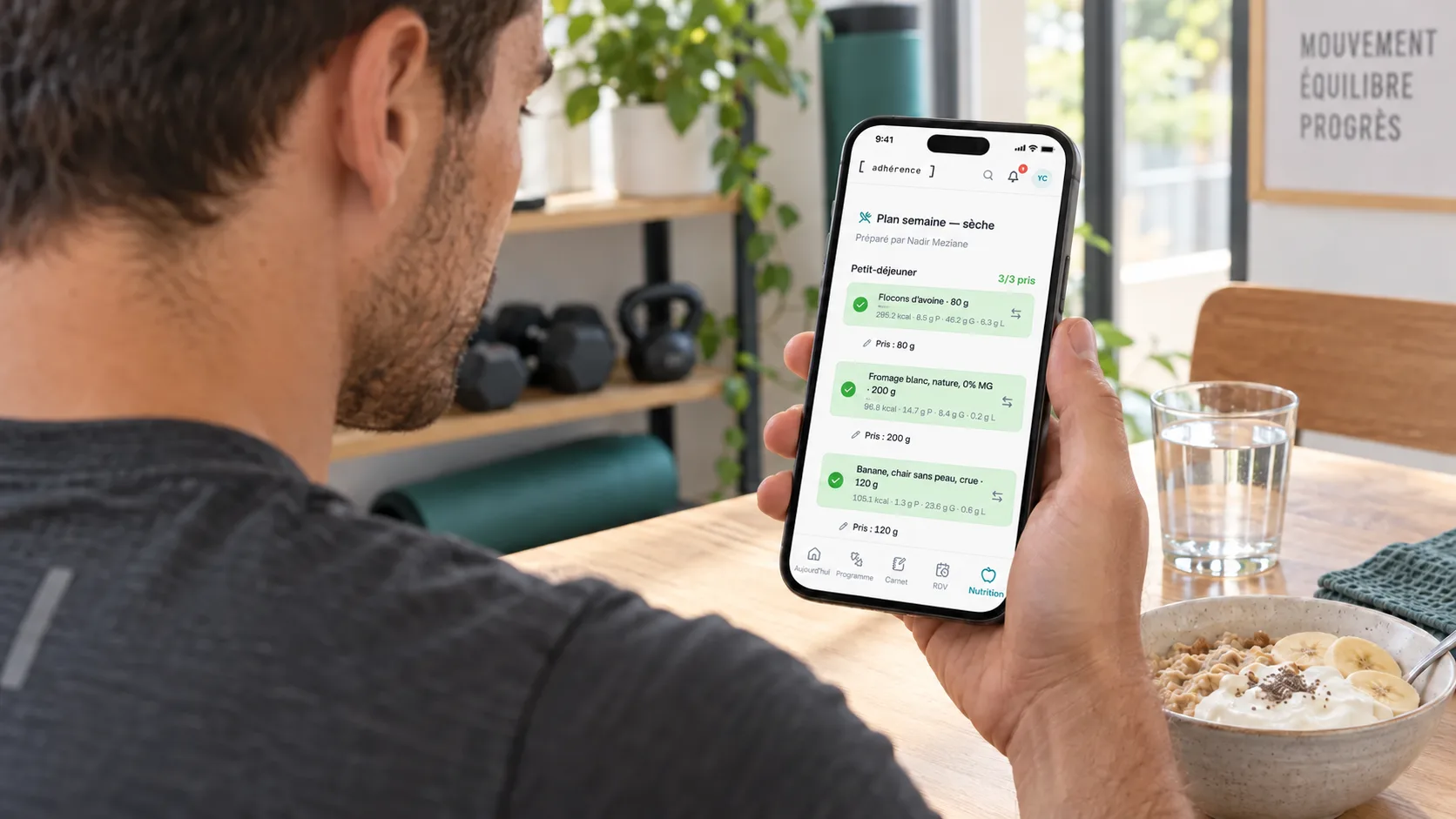
Depending on the selected plan, Adhérence brings together nutrition features, a food diary and weight tracking. Clients can consult their space, record workouts and provide the agreed feedback. That gives the coach a shared base for preparing the next review.
The software does not automatically infer fat loss from a weight change. It does not replace the conversation either. A chart helps display observations across time; interpreting them still requires measurement conditions and the context of the coaching relationship.
The personal trainer software page presents programme and follow-up centralisation. Check the current plans for feature availability. If the client later moves towards a different goal, the guide to tracking muscle gain explains why similar data requires a different interpretation.
Keep the next action visible in your own working routine. The review should end with the client understanding what stays the same, what changes and when you will discuss it again, rather than merely receiving a comment about the direction of a graph.
For recording and conversations, the nutrition follow-up guide distinguishes planned meals, reported entries and useful questions for the next check-in.
What checklist should you use before the next review?
- The goal has been restated without promising a numerical result.
- Each selected indicator supports an identifiable decision.
- Collection conditions are reasonably consistent.
- Missing data has been distinguished from actions not completed.
- The client’s experience and constraints have been discussed.
- The next adjustment has a reason and a review date.
Body measurements and photos deserve particular care. The CNIL’s core data protection principles include minimisation: avoid collecting more than necessary and explain why the requested information is useful to the follow-up.
Frequently asked questions about coaching fat loss clients
Should every client weigh themselves daily?
Discuss frequency according to the information’s usefulness and the person’s comfort. More measurements do not automatically produce better decisions, especially if collecting them becomes stressful or distracts from the agreed actions.
Does one stable week mean the programme has stopped working?
Not on its own. Check measurement conditions, earlier observations and whether the plan was workable before interpreting that week or changing several parameters at the same time.
Are progress photos essential?
No. They can provide a visual reference when the client accepts their use, but they do not precisely measure body fat. They should not determine whether the person can receive useful coaching support.
Key takeaways
Following a client’s fat loss goal means connecting comparable observations, real habits and their experience. Explain the limits of body weight, select a few useful indicators and adjust after verification. A consistent review loop is more helpful than reacting to every fluctuation.
Sources
- Eating & Physical Activity to Lose or Maintain Weight · National Institute of Diabetes and Digestive and Kidney Diseases (NIDDK)
- Changing Your Habits for Better Health · National Institute of Diabetes and Digestive and Kidney Diseases (NIDDK)
- The six core GDPR principles · CNIL
Keep reading
Two related guides for turning an observation into a sustainable tracking method.