Muscle gain coaching: how to track progress and adjust client programmes
Review logged sets, make comparisons meaningful and give each programme adjustment an explicit reason.
Short answer
To follow a muscle gain goal, connect completed workouts, their conditions and client feedback. A heavier load describes performance in a particular context; increasing body weight does not directly measure muscle gained. Check that observations are comparable before adjusting the programme and planning the next review.
Your client lifts more weight and their body weight increases. Is that enough to conclude that they are gaining muscle? Both observations may be useful, but they do not describe exactly the same thing. For a personal trainer, following a hypertrophy goal means connecting completed training, comparison conditions and client feedback before changing the programme.
This guide proposes a review method for adult clients using fictional examples. It does not provide a standard bulking programme. Its purpose is to distinguish useful signals, their limits and the decisions that require an additional check before you act.
What is the difference between strength progress and muscle gain?
A better result on an exercise does not directly measure increased muscle mass. Familiarity with the movement, technique and session conditions can also affect performance. A heavier recorded load needs context before being treated as evidence of a body composition change.
The 2026 ACSM position stand considers strength, hypertrophy and performance separately in healthy adults. For coaching, that distinction is a reminder to interpret a performance indicator and a body composition goal according to their own limits.
The same care applies to body weight. An increase does not identify how much comes from muscle, water or other components. Explain this at the start of coaching so that one value does not become the verdict on the entire week.
“I completed another repetition” describes a recorded performance. “I gained muscle” describes a bodily adaptation. Follow-up can connect these observations, but it should not make them interchangeable.
What should clients record during strength training sessions?
Start with the prescription: exercises, sets, repetitions, load and useful instructions. Ask the client to record what they actually completed. A checked box indicates an action in the application; the set details support a more specific review of the training.
Keep information that makes sessions comparable as well. Different range of motion, equipment or rest periods can influence the observed result. You do not need a long comment after every set, but the client should know how to report a substitution or uncertainty about an instruction.
An effort rating can help when both of you understand the reference consistently. A number without explanation remains difficult to interpret. Occasionally ask the client to describe the experience so you can check that the entry matches the intention of your tracking method.
- Observed signal
- More repetitions
- What it may inform
- Performance progress in that context
- What it does not prove alone
- A measured increase in muscle mass
- Observed signal
- Heavier load
- What it may inform
- A change in completed work
- What it does not prove alone
- Identical execution or range of motion
- Observed signal
- Regular sessions
- What it may inform
- Whether the planned schedule is workable
- What it does not prove alone
- The quality of every set
- Observed signal
- Increasing body weight
- What it may inform
- A change in total body mass
- What it does not prove alone
- How much of that change is muscle
- Observed signal
- Persistent fatigue
- What it may inform
- A need for conversation and verification
- What it does not prove alone
- The exact cause of the difficulty
| Observed signal | What it may inform | What it does not prove alone |
|---|---|---|
| More repetitions | Performance progress in that context | A measured increase in muscle mass |
| Heavier load | A change in completed work | Identical execution or range of motion |
| Regular sessions | Whether the planned schedule is workable | The quality of every set |
| Increasing body weight | A change in total body mass | How much of that change is muscle |
| Persistent fatigue | A need for conversation and verification | The exact cause of the difficulty |
The guide to creating a personalised strength programme explains how to prepare these instructions. The quality of a later review depends partly on how clearly you defined what was expected in the first place.

How can you make two workouts reasonably comparable?
Keep stable reference points for the exercises you want to track. If the client uses another machine, changes an instruction or shortens rest, that difference should appear in the conversation. It does not make the workout worthless; it limits what the comparison can establish.
In a fictional example, Hugo records a heavier load on one movement. During the review, he explains that he used a different machine. His coach keeps the information but avoids comparing the two numbers as though they came from identical equipment. They establish a new reference for future observations.
In another scenario, Emma adds a repetition on a familiar exercise under reportedly similar conditions. The coach can discuss that performance change. They do not turn it into a quantity of muscle gained or use it to promise a particular body composition result.
This discipline avoids two opposite errors: ignoring useful information because it is imperfect, and assigning excessive precision to an approximate observation. The appropriate confidence level depends on what you actually know about the conditions behind the numbers.
What should you check when progress appears to stall?
Begin with consistency and recording. Was the client able to complete the prescribed sessions? Are the values complete? Missing entries require clarification before you treat them as missing training. Otherwise, the next decision may answer a problem that never occurred.
Check constraints and understanding next. A shorter training slot, unavailable equipment or an unclear instruction may explain part of the discrepancy. Adding more work without resolving that obstacle can make the programme even less practical for the client.
Then discuss their experience, recovery and current circumstances. One reply cannot identify a single cause. Repeated difficulty or pain, however, needs appropriate attention within your competence and referral to a suitable professional when necessary.
In a fictional case, a client regularly misses the final part of an overlong workout. The coach first revises its structure with them. They record the reason and observe whether the new arrangement is workable before changing several other training parameters at the same time.
When should you adjust a muscle gain programme?
An adjustment may respond to a planned stage, a new constraint or a difficulty observed across several comparable sessions. State the hypothesis before modifying the plan. “The workout exceeds the available time” is more specific than “the programme no longer works”.
Choose a change that fits the hypothesis and your competence. Explain what changes, what remains stable and what you will observe together. When everything changes simultaneously, the next review provides less information about the effect of the decision.
Plan a review instead of promising immediate improvement. Progress does not need to become an instruction to beat a number at every workout. The weekly coaching check-in helps examine patterns and obstacles without rewriting the programme after every variation in a recorded result.
For nutrition and weight, maintain the distinction between estimates and measurements. A food diary can support a conversation about organisation; it does not provide an exact measurement of intake. Body changes require careful interpretation rather than an identical eating target for every client.
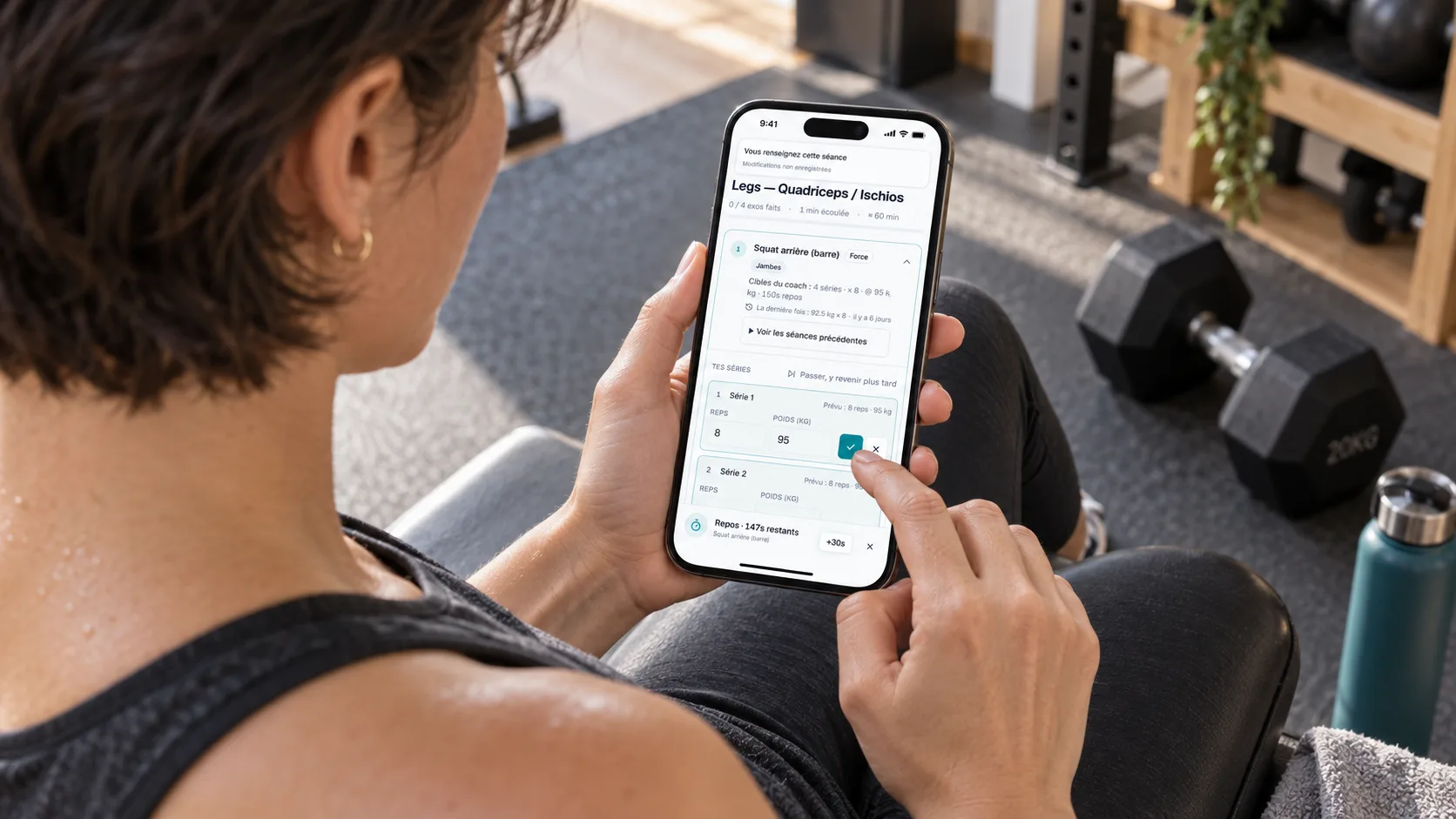
How can Adhérence centralise hypertrophy follow-up?
Adhérence brings together the prescribed programme and sessions logged by the client. Coaches can review recorded values and prepare a discussion of completed training. Depending on the plan, weight and nutrition features provide complementary information to discuss with the client.
This workflow does not directly measure muscle growth or automatically validate exercise execution. It makes information more accessible for your coaching work. Conversation remains necessary when data is missing, a movement changes or a difficulty appears during the programme.
The personal trainer software page presents the workflow, and the pricing page explains current plan availability. For managing several clients, the client tracking indicators guide proposes a review that separates training, context and administration.
If you collect measurements or photos, explain their purpose and respect the client’s comfort. The CNIL’s core data protection principles include purpose limitation and minimisation: collect the information the coaching relationship actually needs, rather than every possible personal detail.
What should you check before changing the prescription?
- Completed workouts have been distinguished from the prescribed programme.
- Missing values have been clarified with the client.
- Equipment, instructions and comparison conditions are known.
- Performance has not been treated as a muscle mass measurement.
- The client’s experience and practical constraints have been discussed.
- The proposed change includes a hypothesis and a review date.
Keep the explanation understandable to the client. They should leave the review knowing why you made the decision and what feedback will help next time. A detailed record that only the coach understands is less useful than a small, shared set of clear reference points.
Frequently asked questions about tracking muscle gain
Does increasing body weight mean a client is gaining muscle?
Not on its own. Body weight represents total mass. Interpret it alongside measurement conditions, other observations and the client’s goal without automatically attributing the change to muscle tissue.
Should clients increase the load every session?
A progression decision depends on the prescription and the observations. A systematic increase does not replace checking understanding, execution conditions and whether the programme remains workable for the individual client.
Does a week without a new performance require a programme change?
No. First check what is comparable and what was actually completed. A pattern and a contextual conversation support the decision better than one isolated result from a single workout.
Key takeaways
To follow a muscle gain goal, organise your review of completed training, make comparisons understandable and distinguish performance, body weight and hypertrophy. Adjust for an explicit reason and plan the next review. Software brings observations together; your role is to make a decision proportionate to what they actually show.
Sources
- Resistance Training Prescription for Muscle Function, Hypertrophy, and Physical Performance in Healthy Adults: An Overview of Reviews · American College of Sports Medicine / Medicine & Science in Sports & Exercise / PubMed
- The six core GDPR principles · CNIL
- Adhérence plans and features · Adhérence
Keep reading
Two related guides for turning an observation into a sustainable tracking method.