Create a personalised strength programme for clients: a coach’s method
From assessment to the first review: build a clear, workable prescription and an actionable feedback loop.
Short answer
To create a personalised strength programme, start with the client’s goal, available time, equipment and experience. Adapt a template, explain the instructions and agree on the feedback to record. Then adjust through logged sessions and conversation instead of changing every training variable each week.
Creating a personalised strength training programme means more than changing the name on a template. For a personal trainer, individualisation begins with the client’s circumstances and continues when completed sessions reveal what actually works. A usable programme explains what to do, how to record the workout and when to ask for an adjustment.
This guide follows that workflow: turn an initial assessment into clear instructions, then use feedback to revise the plan. All client examples are fictional. They illustrate coaching decisions rather than provide an individual exercise prescription or a universal training protocol.
What should you learn before writing a client’s programme?
Start with the goal in the client’s own words. “Build muscle” gives you a direction, but it does not yet define practical success. Ask what the person hopes to do, how much time they can allocate to training and what they expect from your support.
Then establish the constraints: available days, realistic session length, accessible equipment, familiarity with movements and other physical activities. A plan built around a fully equipped gym becomes hard to follow if the client sometimes trains at home. A theoretical availability is different from a slot that actually exists in their diary.
The initial client assessment guide helps structure that conversation. Collect information that supports a decision without turning onboarding into an exhaustive medical file. Pain, contraindications or health circumstances may require assessment by an appropriate professional. Work within your competence and account for any relevant professional guidance.
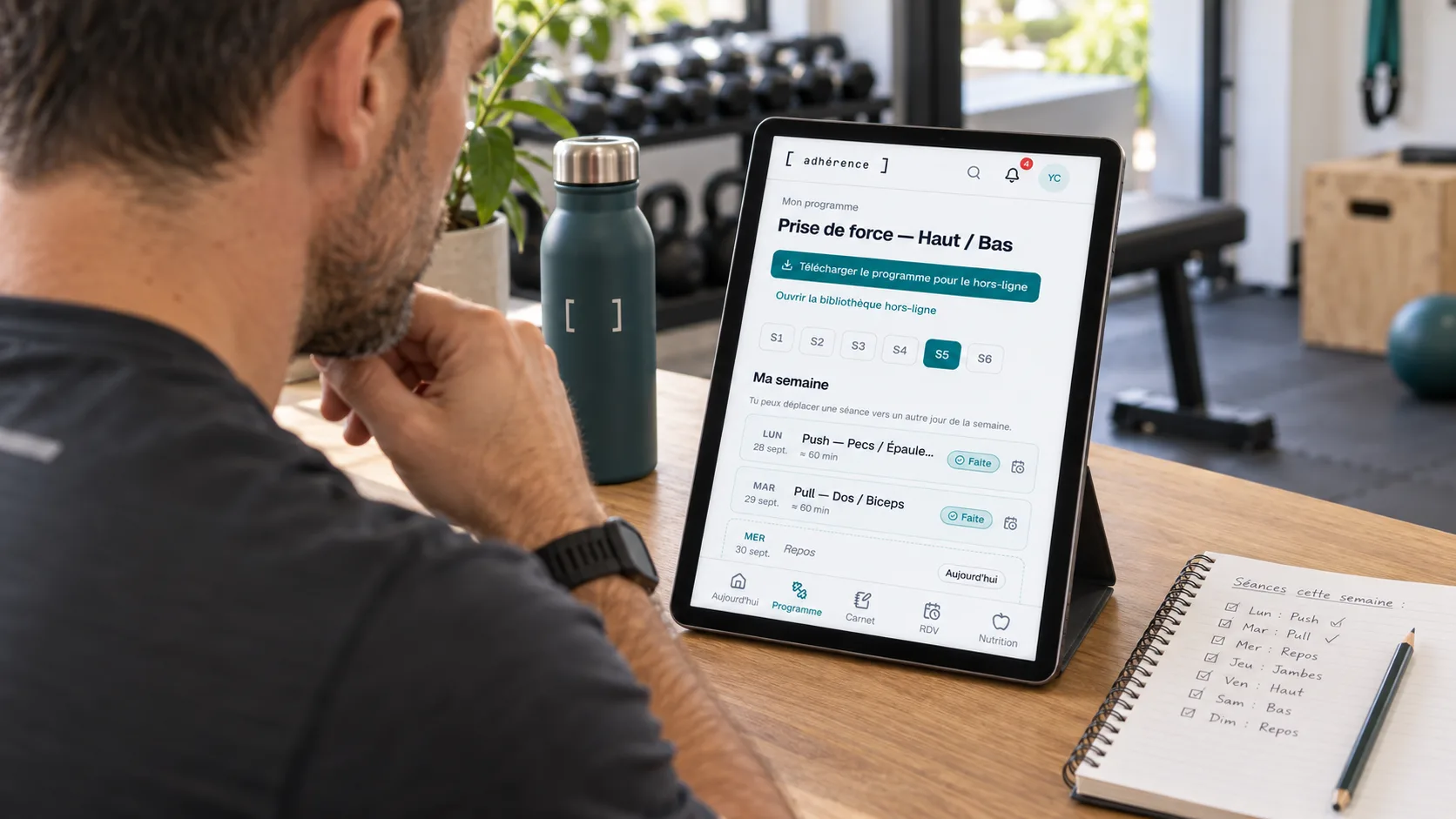
Also check the practical starting point: can the client find the plan and understand how to report a session? A well-designed routine cannot support follow-up if accessing it is already a source of friction.
Can a template still produce a personalised training programme?
Yes, when it remains a starting point. A template saves you from rebuilding a familiar structure, but important choices still need a reason for this client: frequency, exercises, distribution, difficulty and the approach to progression.
In a fictional example, Lina offers three weekly training slots, but work regularly disrupts one of them. Her coach starts by organising a workable structure around the reliable slots, then clarifies the role of the third. Here, personalisation concerns feasibility before adding another exercise.
The 2026 ACSM position stand distinguishes strength, hypertrophy and performance adaptations in healthy adults. It supports goal-sensitive prescription. It does not turn one general rule or an identical number of sets into an individual programme for every client.
A template becomes personalised when you can explain what you kept, what you changed and why. If the client’s name is the only difference, the coaching decision still needs to happen.
What makes a strength workout easy for a client to follow?
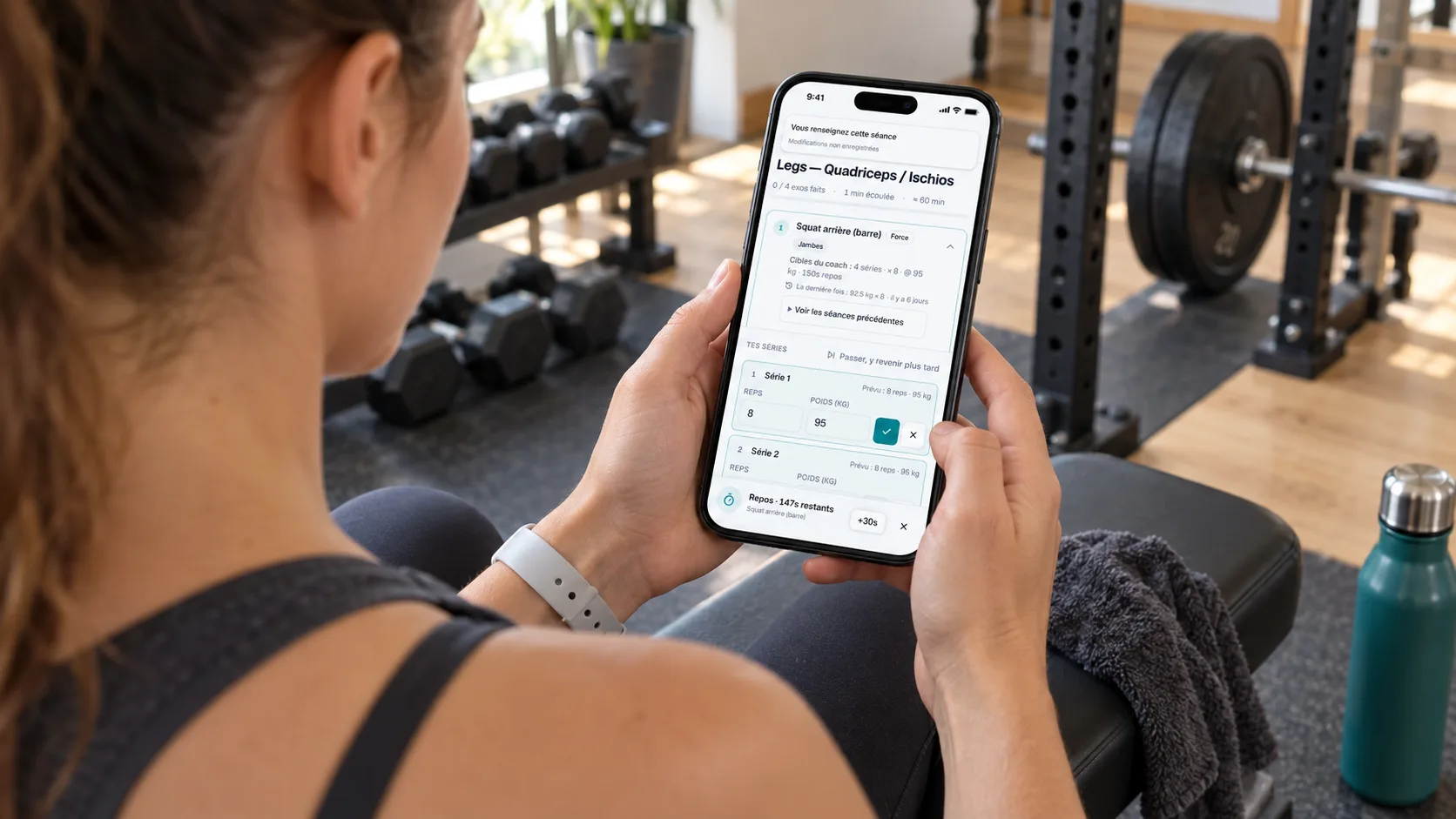
The client should identify the movement, the intended work, the useful instructions and what to record. Lengthy explanations do not compensate for an ambiguous instruction. Write for someone checking a phone between sets in a noisy gym with plenty of distractions.
Specify the parameters your prescription needs: sets, repetitions, rest, load or an effort cue where appropriate. Explain abbreviations when you first introduce them. If you use RPE, check that the client understands your reference rather than assuming the same score means the same experience to everyone.
- Element
- Exercise
- What the client should understand
- Which movement and instruction to follow
- What the coach can review
- Whether sessions are comparable
- Element
- Sets and repetitions
- What the client should understand
- The intended work
- What the coach can review
- The work actually recorded
- Element
- Rest and effort
- What the client should understand
- How to approach the next set
- What the coach can review
- The context of a difficulty
- Element
- Alternative
- What the client should understand
- What to do when equipment is unavailable
- What the coach can review
- Why an exercise changed
- Element
- Expected feedback
- What the client should understand
- Which values or notes to enter
- What the coach can review
- Which adjustment to discuss
| Element | What the client should understand | What the coach can review |
|---|---|---|
| Exercise | Which movement and instruction to follow | Whether sessions are comparable |
| Sets and repetitions | The intended work | The work actually recorded |
| Rest and effort | How to approach the next set | The context of a difficulty |
| Alternative | What to do when equipment is unavailable | Why an exercise changed |
| Expected feedback | Which values or notes to enter | Which adjustment to discuss |
A demonstration video can help explain a movement. It does not prove that the client’s actual execution matches your instruction. Agree on a way to resolve uncertainty: conversation, observation within the coaching arrangement or an appropriate exercise adaptation.
How can you define progression without changing everything each week?
Choose reference points that remain stable enough for comparison. If you change the exercises, order, repetition target and rest at the same time, an apparent improvement becomes difficult to interpret. Variation may be useful, but it should answer an identifiable need.
Write down what would trigger a discussion about adjustment. Examples include a repeatedly misunderstood movement, a workout that consistently exceeds the available slot or recorded values that no longer fit the programme’s intention. These observations invite a check; they do not automatically instruct the client to increase the load.
For a fictional client, two logged sessions show different repetition counts on the same exercise. Before changing the prescription, the coach checks rest, understanding and execution conditions. The relevant question is not just “how much?” but “under what circumstances?”.
Effort and recovery feedback provide context. One poor night’s sleep does not by itself require a complete redesign. Conversely, persistent difficulty deserves attention even when every checkbox is filled. The guide to tracking muscle gain develops this distinction between a recorded signal and a justified decision.
How should you organise a new client’s first week?
Introduce the programme and feedback process before expecting complete independence. Show the client where to find a workout, how to record a set and how to report an obstacle. The first review also tests whether your coaching system is understandable.
Ask a specific question instead of requesting a broad verdict. “Which exercise needed another explanation?” or “did the workout fit your available time?” produces actionable information. An answer such as “all good” may hide an improvised substitution or a shortened session.
In a fictional case, a client substitutes a movement because a machine is occupied. When that change appears in their feedback, the coach can agree on a suitable alternative. Without the context, the coach might mistake a different recorded load for a progression issue.
Agree on the next review as well. Clients should know when you will read their feedback and which issues require earlier contact. The weekly coaching check-in method formalises this loop without asking for an extensive report after every workout.
How can you create and follow the programme in Adhérence?
Adhérence lets coaches create programmes, use templates and assign workouts to their clients. Clients find the programme in their own space and record their training. The coach can compare the prescription with logged information instead of searching a conversation for the latest document version.
That comparison supports a review; it does not make the decision for you. A logged set does not validate technique. Missing entries do not demonstrate that a workout never happened. Check the situation with the client before drawing a conclusion.
The personal trainer software page presents the workflow and complementary features. Plan conditions can change, so check the current pricing to distinguish availability across subscriptions. Evaluate the tool through the whole cycle, from preparation to reading the client’s feedback.
If you still use separate documents, the Excel and Adhérence comparison helps identify what to centralise. A useful migration preserves the instructions the client needs and gives them a clear place to find the programme currently in use.
The hybrid coaching guide complements this workflow when independent training alternates with in-person appointments: preserve instructions between both formats.
What should you check before sending the programme?
Read the workout from the client’s perspective. Imagine unavailable equipment, an unfamiliar abbreviation and an interruption during training. Each foreseeable difficulty should have a simple answer or an agreed route for clarification. A brief explanation before the first session can prevent repeated uncertainty later.
- The goal and constraints have been restated with the client.
- The week fits genuinely available training slots.
- Exercise instructions and training parameters are understandable.
- Useful alternatives have been discussed.
- The client knows which sets and feedback to record.
- The first review date and contact channel are clear.
Frequently asked questions about personalised training programmes
How many exercises should a session contain?
There is no single useful number for every client. The choice depends on the goal, experience, available time and prescription. Check that the session is workable and understandable before treating exercise count as a quality measure.
Should the programme change every week?
A change should respond to an observation or a planned stage. Keeping stable reference points helps you interpret feedback and avoid modifications whose purpose you cannot explain to the client.
Which client information should you retain?
Keep information that supports follow-up and explain its purpose. The CNIL’s data protection principles include purpose limitation and minimisation: collecting personal information should answer an identified need.
Key takeaways
A personalised strength programme connects a goal, real constraints and a feedback loop. Start from a template if useful, make the instructions clear and adjust through comparable sessions and conversation. Software supports that continuity; the coaching judgement remains yours.
Sources
- Resistance Training Prescription for Muscle Function, Hypertrophy, and Physical Performance in Healthy Adults: An Overview of Reviews · American College of Sports Medicine / Medicine & Science in Sports & Exercise / PubMed
- The six core GDPR principles · CNIL
- Adhérence plans and features · Adhérence
Keep reading
Two related guides for turning an observation into a sustainable tracking method.