Hybrid personal training: connect in-person sessions with remote follow-up
Keep instructions current, review independent training and prepare the next appointment from client feedback.
Short answer
Hybrid personal training combines appointments with the coach and independent workouts followed remotely. Give each format a purpose, preserve instructions in the current programme and define expected feedback. Then prepare the next appointment from observations, with explicit review periods and realistic response times.
A client sees you at the gym, trains independently and returns with questions about a home workout. If instructions live in a notebook, the programme in a PDF and feedback in a conversation, each appointment starts with reconstruction. Hybrid personal training aims to preserve coaching continuity between in-person sessions and remote follow-up.
This guide explains how to organise that continuity. It does not cover the general launch of an online business, which has its own guide. All examples are fictional and illustrate the division of work between formats rather than prescribe an ideal frequency for every client.
What is hybrid personal training?
Hybrid coaching combines time with a trainer and independent training followed remotely. In-person sessions can help clarify movements, examine a difficulty or conduct a review. Follow-up between appointments preserves instructions and prepares the next coaching decision from the client’s actual experience.
It is more than a gym session with unlimited availability on WhatsApp. Clients should know what is included, how to request clarification and when their feedback will be read. A clear arrangement prevents a broad promise of support from becoming a sequence of unlimited, undefined requests.
In a fictional example, a client alternates an accompanied session and several independent slots according to her schedule. The frequency is agreed with her. The trainer uses appointments to address observed difficulties and remote feedback to prepare those conversations.
If you are defining your service for the first time, the guide to launching online personal training explains its scope. The question here is how to connect two formats within one client journey rather than launch a separate product for each.
How should you divide in-person and remote coaching tasks?
Give each moment a purpose. Time with you can focus on something that benefits from direct interaction. The written programme then preserves instructions for independent sessions. Recorded feedback helps prepare the next review instead of requiring the client to recall everything later.
Avoid requesting the same extensive report after every workout. Ask for what informs a decision: completed sets, a substituted movement, a shortened session or an identified difficulty. Short, understood feedback is often more usable than a long report you cannot consistently review.
- Moment
- Before an appointment
- Main purpose
- Prepare a question or difficulty
- Information to retain
- Useful feedback from the period
- Moment
- During in-person coaching
- Main purpose
- Observe and clarify
- Information to retain
- Agreed instructions
- Moment
- Between appointments
- Main purpose
- Complete independent training
- Information to retain
- The work actually recorded
- Moment
- During the review
- Main purpose
- Decide whether to maintain or adapt
- Information to retain
- The reason and next review point
| Moment | Main purpose | Information to retain |
|---|---|---|
| Before an appointment | Prepare a question or difficulty | Useful feedback from the period |
| During in-person coaching | Observe and clarify | Agreed instructions |
| Between appointments | Complete independent training | The work actually recorded |
| During the review | Decide whether to maintain or adapt | The reason and next review point |
A personalised programme connects constraints with a clear prescription. Individualisation continues when independent sessions reveal unavailable equipment or a schedule that is harder to maintain than the initial consultation suggested.
How can you preserve instructions after an accompanied session?
Finish the appointment by checking the next workout. The client should know where to find the current programme, which exercise changed and what to record. Ask them to explain the next step instead of ending with a broad “is everything clear?” question.
Write down instructions that need to survive the conversation. A correction explained in the gym but absent from the programme may be forgotten during the next independent session. Avoid keeping two competing versions without identifying which one currently applies to the client.
In a fictional case, an exercise changes because the client lacks the required equipment at home. The coach updates the instruction and verifies phone access. The next workout connects intended training with what the client could actually complete in that environment.
Coaching continuity becomes visible when the client is alone: can they find the current instruction, take the next step and report an obstacle without reconstructing the last appointment from memory?

Which information should clients report between appointments?
Start with completed work and the context behind a difference. A workout may be partly recorded because it was shortened, but also because an entry was forgotten. Missing information does not automatically establish that the client did not train.
Ask for brief feedback about useful difficulties: understanding, equipment, time or experience. Clients should know when a question warrants contact before the next review. The channel and response time need to match the service you actually provide rather than an implied permanent availability.
The 2023 review of exercise adherence highlights heterogeneous measures within its rehabilitation context. It does not demonstrate hybrid coaching superiority. The method proposed here distinguishes observations instead of reducing the whole coaching relationship to a count of attended appointments.
The client tracking indicators guide helps interpret that information. In-person attendance, training and administration should remain understandable separately before being connected during a review of the client’s wider circumstances.
How should feedback shape the next in-person appointment?
Read available information before the accompanied session and choose a small number of topics. The appointment should not become entirely dedicated to completing missing diary entries. Clarification can be brief and leave time for the work planned with the trainer.
In a fictional example, a client reports two exercise substitutions at home. The coach prepares a conversation about available equipment and an appropriate alternative. The next appointment checks understanding instead of repeating the unchanged initial programme and hoping that the obstacle disappears.
Afterwards, retain the decision and the next observation you expect. When you change several parameters, explain their reason; when you maintain the plan, clarify what you will keep reviewing. The client should understand why the next check matters to their individual situation.
The weekly check-in method can complement appointments depending on your offer. Its frequency follows the service and identified needs. It does not imply that the trainer reads every recorded value instantly after it is entered.
How can you manage the calendar and follow-up workload?
Count both accompanied time and review time. A format with fewer appointments can still require preparation, replies and adaptations. Allocate realistic periods for those tasks so that remote support remains consistent with the service and the number of clients you manage.
Online booking organises appointments with you. It should not be confused with moving an independent workout in the programme. Check the location when meetings alternate between a gym, the client’s home and another venue.
If you offer a pack, explain what consumes a credit. The session pack management guide distinguishes a committed appointment from a logged independent workout. Remote follow-up should not create an implicit deduction the client only discovers later.
Connect this organisation with your coaching prices. The price should reflect the communicated scope, including conversations and preparation, rather than depend on an assumed unlimited availability that neither person has clearly agreed.
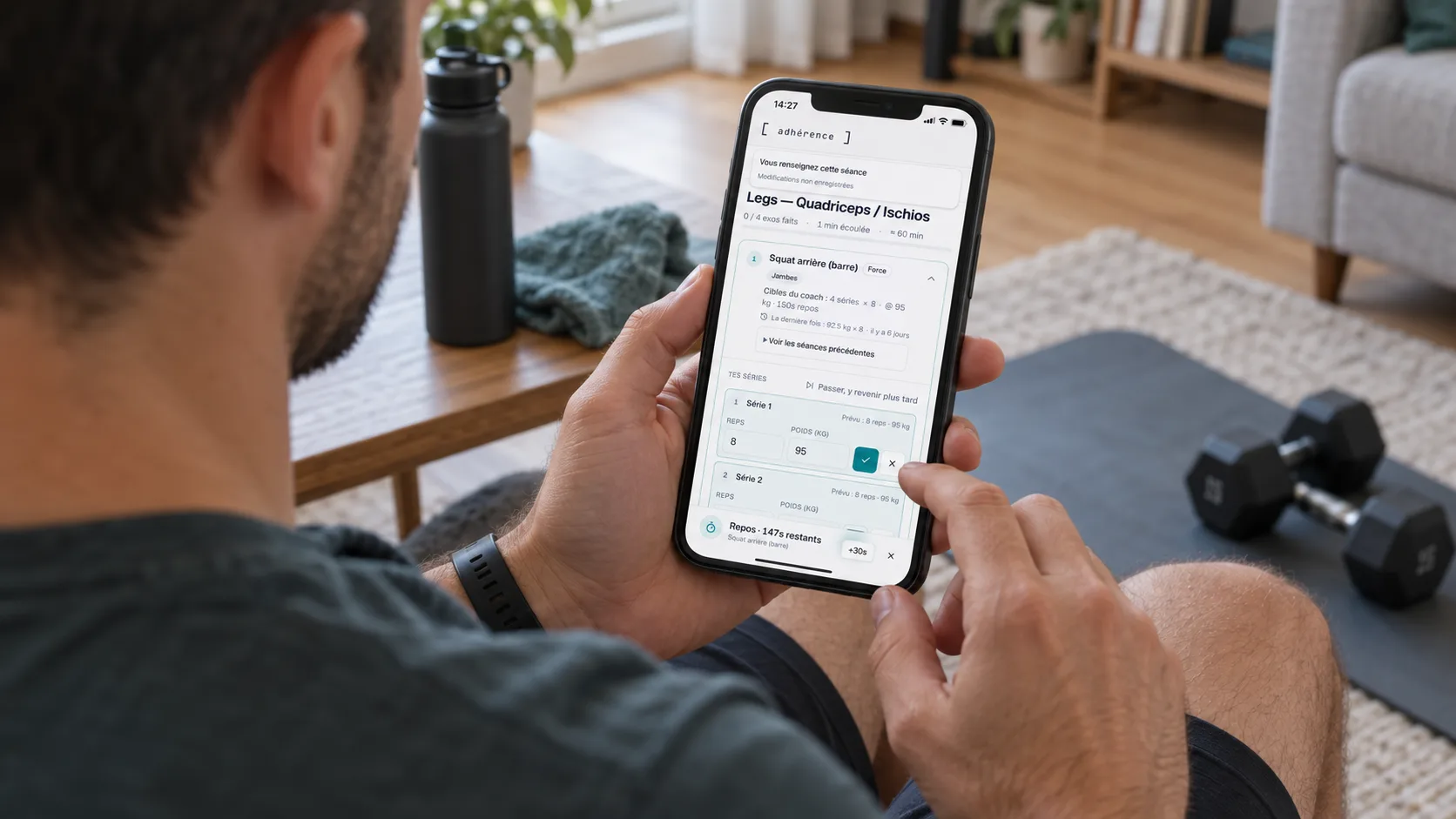
How can you organise hybrid coaching in Adhérence?
Coaches create and assign programmes; clients find their workouts and record their training. This preserves the prescription and feedback between appointments. Free lets you test the journey with up to five clients before deciding which complementary features your service needs.
Pro adds functions including the calendar, booking, nutrition and weight tracking. Business adds packs and payment management. The current plans help you verify the scope suitable for your hybrid coaching service without promising every feature at every subscription level.
Training can be recorded offline through the supported workflow when the programme is available on the device. Check access and the return of data before relying on an immediate review. Adhérence does not provide an integrated videoconferencing tool you should assume is included in your offer.
Personal one-off workouts are private by default, so not all client activity is necessarily visible to the coach. Explain what is shared and limit requested information in line with the CNIL’s principles. Programme and feedback visibility should serve an arrangement understood by both people.
What should your continuity checklist include?
- Each format has a purpose explained to the client.
- The current programme contains the useful instructions.
- The client knows which values and obstacles to report.
- Review periods and response times are clear.
- Appointments remain distinct from independent workouts.
- The next review uses feedback and produces an understandable decision.
Frequently asked questions about hybrid personal training
How many in-person sessions should you plan?
There is no frequency suitable for everyone. Decide with the client according to their goal, autonomy, constraints and the service scope. The examples in this guide are not a calendar to reproduce for every person.
Should you respond to every entry immediately?
Communicate a realistic workflow. A planned review can be useful when the client knows when it happens and how to report a question that needs clarification before the next training session.
Does remote follow-up replace observing training in person?
The formats provide different information. Recorded values do not automatically validate execution. Use appointments and the agreed means of coaching to address questions that need direct observation rather than drawing conclusions from numbers alone.
Key takeaways
Hybrid coaching forms a loop: prepare, accompany, preserve instructions, review independent training and decide the next step. Clarify each format’s purpose and protect review time. An accessible programme and understood feedback make the next appointment easier to prepare and more connected to the client’s real experience.
Sources
- Measurement, determinants, barriers, and interventions for exercise adherence: A scoping review · Journal of Bodywork and Movement Therapies / PubMed
- The six core GDPR principles · CNIL
- Adhérence plans and features · Adhérence
Keep reading
Two related guides for turning an observation into a sustainable tracking method.