Body measurements and progress photos: how should trainers organise tracking?
Choose useful references, explain collection conditions and prepare a review that respects the client.
Short answer
Track body measurements and progress photos by agreeing relevant indicators, defining a repeatable procedure and planning the review. Connect observations to the goal without inferring exact body composition from a photograph. In Adhérence, numeric check-in questions, photos and weight history have separate roles that the trainer connects with the client’s context.
Tracking body measurements and progress photos helps a personal trainer when the information is comparable, agreed with the client and relevant to their goal. Define the reference, conditions and frequency before collecting it. Then interpret several observations with context, rather than turning one photograph or centimetre into a verdict about results.
This guide covers the tracking method, rather than a medical assessment of body composition. It complements the fat-loss and muscle-gain guides. The aim is useful, respectful information, not an ever-growing collection of details about a client’s body that nobody can clearly explain or review.
Which body measurements should you track?
Start with the client’s goal and agreement about the method. Someone working on consistent training may not need a set of body measurements. Another person may want a particular reference. Ask what the information will help you discuss, then retain only indicators relevant to the coaching service and their preferences.
Name each measurement unambiguously. “Waist circumference” becomes difficult to compare when the anatomical reference changes between entries. Explain the chosen location and unit. If a value comes from a professional or another protocol, preserve that distinction instead of treating every entry as an interchangeable point within the same series.
A study of home body measurements examined a taught method with forty-one mothers of young children. It addressed reliability in that context, not coaching effectiveness. The practical implication is to teach an understandable procedure; this does not make every individual measurement infallible or establish the same performance in every population.
How can you make measurements comparable?
Write a short instruction: the same reference, equipment, agreed posture and reasonably similar conditions. Demonstrate the process initially, then ask the client to explain it back. A diagram or personal demonstration may be clearer than technical terms that the person interprets differently. Confirm what will count as the reference for future entries.
When two observations seem inconsistent, check the method before concluding that physical change occurred. Different tape tension or a shifted reference can explain a difference. You can request another check under the agreed conditions, preserving why that check was needed. An uncertain value should remain visibly uncertain rather than quietly replacing the earlier record.
- Reference
- Selected circumference
- Condition to describe
- Location, unit and method
- What it cannot establish alone
- Exact body composition
- Reference
- Recorded weight
- Condition to describe
- Context and a series of observations
- What it cannot establish alone
- The cause of every fluctuation
- Reference
- Progress photo
- Condition to describe
- Framing, lighting and posture
- What it cannot establish alone
- An objective body-fat measurement
- Reference
- Performance
- Condition to describe
- Comparable exercise and conditions
- What it cannot establish alone
- Every aspect of physical change
| Reference | Condition to describe | What it cannot establish alone |
|---|---|---|
| Selected circumference | Location, unit and method | Exact body composition |
| Recorded weight | Context and a series of observations | The cause of every fluctuation |
| Progress photo | Framing, lighting and posture | An objective body-fat measurement |
| Performance | Comparable exercise and conditions | Every aspect of physical change |
Choose a frequency that supports reliable collection and actual review. The schedule should match your service, the goal and the client’s comfort. Present it as an agreed organisation rather than a universal biological rule. More entries cannot compensate for a procedure that the person understands differently every time they use it.
How should you request useful progress photos?
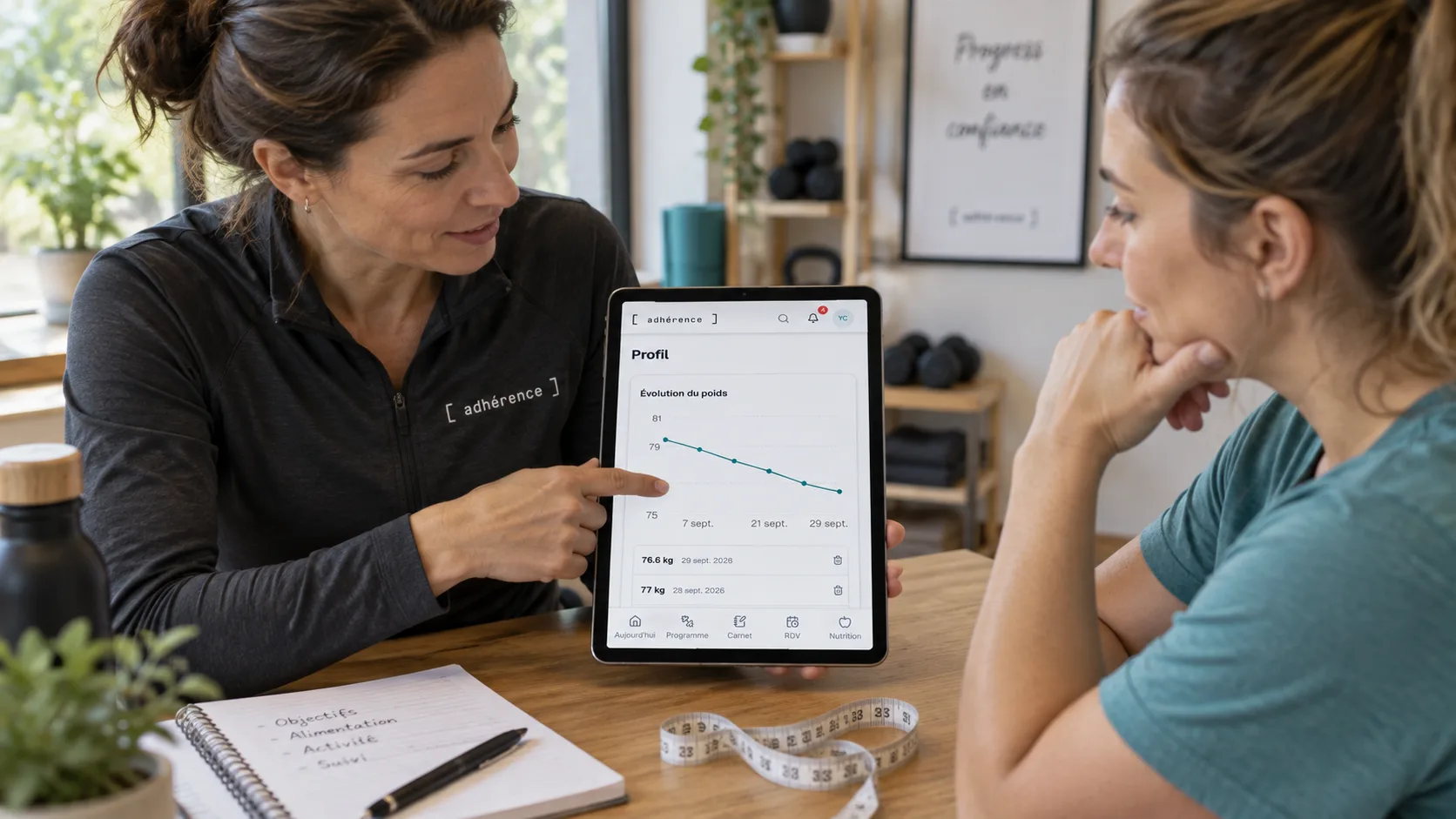
Explain what you intend to observe and offer an appropriate alternative when someone does not want photos. Training records, feedback or another relevant indicator can support the review. Avoid presenting body exposure as proof of commitment or an implied requirement for receiving the trainer’s attention and a thoughtful response.
When photos are agreed, define repeatable framing: distance, angle, lighting, posture and comparable clothing. Lighting changes can alter the visual impression. Images support a contextual conversation; they do not calculate body-fat percentage or prove the cause of an apparent change. Keep that distinction clear when describing what the review can establish.
Plan storage and reading as well. A dated photo linked to the correct client is easier to retrieve than a file lost in a conversation. In Adhérence, progress photos and photos requested within check-ins can organise collection. Specify what you review, when and why so that clients understand what follows their submission.
How can you organise measurements in an Adhérence check-in?
Adhérence’s customisable check-ins support numeric questions, text and photos. You can request a circumference by specifying its unit and method in the question, then ask for context about the conditions. One precise question is often easier to answer and interpret than several fields whose definitions remain implicit or change between forms.
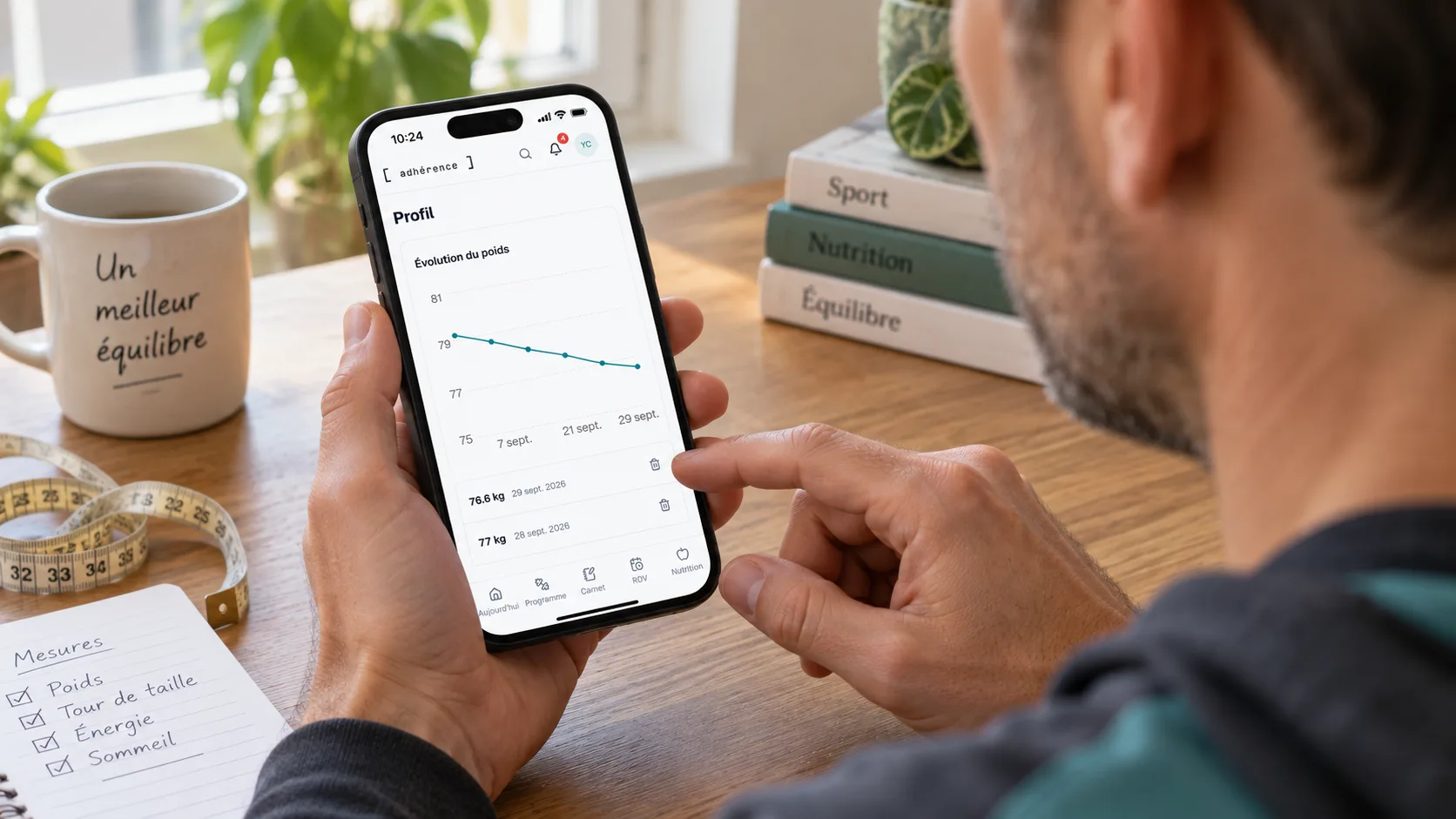
Collecting a value in a check-in does not mean a dedicated chart exists for every body circumference. Weight tracking has its own history. Questionnaire responses, photos and that history are separate supports that you connect during your review. Choose a presentation matching the actual functions rather than describing every numeric response as a chart.
Use the initial consultation and weekly check-in guides to prepare questions. You do not need to repeat the complete questionnaire every week. A planned body measurement and a question about a training obstacle can follow different schedules while remaining part of the same service and longer-term conversation.
Comparable information comes with known conditions. Before interpreting a change, check the reference, the method and whether the client still wants to use this form of tracking for their current goal.
How should you read weight, measurements and photos together?
Connect observations without forcing them to agree. Weight, circumference and visual impression do not measure the same thing. Different changes are not necessarily contradictions. State what you observe, what remains uncertain and the question needed to prepare the next decision. This makes your reasoning easier for the client to assess and discuss.
In a fictional example, a client reports a waist change while recent weight remains similar. Her trainer discovers that the measurement reference changed. They revisit the procedure and keep performance and training consistency as other discussion points. The trainer does not calculate fat loss from that difference or turn it into a transformation claim.
This is not a customer result achieved with the software. It illustrates why context precedes conclusions. At the monthly review, select observations you can explain and decide together what to maintain or check. A smaller number of understood references can support a clearer conversation than a dense page of uncertain comparisons.
How should you protect photos and collected information?
Explain who accesses the information and for what purpose. A coaching photo is not automatically available for marketing. The CNIL explains that identifiable sports photographs are personal information. That document addresses amateur sport; the circumstances and intended use of your own service also need to be considered before applying its guidance.
Keep tracking and publication clearly separate. Someone sending an image for a coaching review has not thereby authorised Instagram, website or advertising use. Before another use, check the relevant framework and permission. Hiding a name in a screenshot may still leave the person identifiable, so do not assume that removing one label makes sharing appropriate.
The CNIL’s core principles provide a reference for purpose and minimisation. Define useful collection and appropriate retention instead of accumulating images for unspecified future needs. Reconsider the process when the goal changes or the client wants to continue with different indicators and a different relationship to body tracking.
Checklist for understandable body tracking
Frequently asked questions
How often should I request body measurements?
Agree a schedule suited to the goal, procedure quality and your review rhythm. Do not present one frequency as mandatory for everyone. An understood, reviewed submission is more useful than frequent measurements with changing conditions or entries that never receive a response explaining how they affect the service.
Can a progress photo establish body-fat percentage?
A progress photo does not provide an objective body-composition measurement. Lighting, posture and framing affect interpretation. Use it carefully alongside other observations without assigning a percentage or a precise cause from the image alone. Keep the distinction between a visual impression and a measured outcome understandable to the client.
Does Adhérence have a chart for every body measurement?
This guide uses numeric check-in questions for circumference collection, photos for visual tracking and the dedicated history for weight. It does not describe a native chart for each circumference. Check which support matches the information requested, and keep that description accurate when presenting the service to clients.
Key takeaways
Body measurements and photos require comparable conditions, agreed collection and careful interpretation. In Adhérence, organise check-in questions, photos and weight history according to their separate roles. Keep the client’s purpose central and use the review to decide the next step, without overinterpreting one isolated difference or promising a precise physical result.
Sources
- Reliability and criterion validity of self-measured waist, hip, and neck circumferences · BMC Medical Research Methodology / PMC
- Questions and answers about data in amateur sport · CNIL
- The six core GDPR principles · CNIL
Keep reading
Two related guides for turning an observation into a sustainable tracking method.