WhatsApp vs Adhérence: how to organise personal training follow-up?
Keep conversation accessible while connecting feedback to workouts: a comparison focused on the trainer’s review.
Short answer
WhatsApp suits quick exchanges and client relationships. Adhérence is more suitable for assigning a program, recording workouts and reviewing adherence in a trainer view. You can keep a conversation channel while giving the program and training records a clear reference space.
WhatsApp or Adhérence for personal training follow-up? WhatsApp suits quick exchanges and client relationships. Adhérence is more suitable for assigning programs, recording workouts and reviewing adherence in a trainer view. You can keep a conversation channel while moving the training log out of the message thread.
This comparison is written by Adhérence’s publisher, with features checked on 1 October 2026. The situations described are fictional. It concerns the organisation of coaching follow-up rather than the overall quality of either messaging service.
Receiving a message is different from having a recorded workout. “Today felt hard” helps you understand the client’s experience. To adapt the program, you also need to know which workout took place and what the client recorded.

Why does WhatsApp work well with clients?
WhatsApp supports written and voice messages. A client familiar with the application can ask a question or explain a disruption with little preparation. That convenience matters when someone hesitates to seek help.
For a schedule change, encouragement or clarification, conversation is often enough. The trainer can respond personally and adapt to the situation. That closeness remains an important part of the service even when programs are managed elsewhere.
The difficulty begins when the same thread contains the program, completed weights, feedback, documents and administrative requests. Each exchange may make sense on its own while the complete week becomes difficult to reconstruct. Consider the work needed at review time, not only the ease of sending a message.
Why is a conversation different from a tracking dashboard?
Messages arrive according to when the client replies. The trainer often searches by a different structure: a specific workout, week, exercise or promised decision. They need to connect separate exchanges to recover that structure.
Fictional example: Hugo receives his program on Monday, sends his weights on Wednesday and explains on Friday that he moved a workout. On Sunday, his trainer rereads several exchanges to understand what is still planned. Nothing necessarily went missing; the work is rebuilding the connections.
Good conventions can reduce this problem. Asking for the workout name, date and a common feedback format already helps. However, those conventions need explanation and maintenance; messages do not automatically become a structured training history. Observe whether clients follow the format before relying on it for your review.
What does Adhérence change?
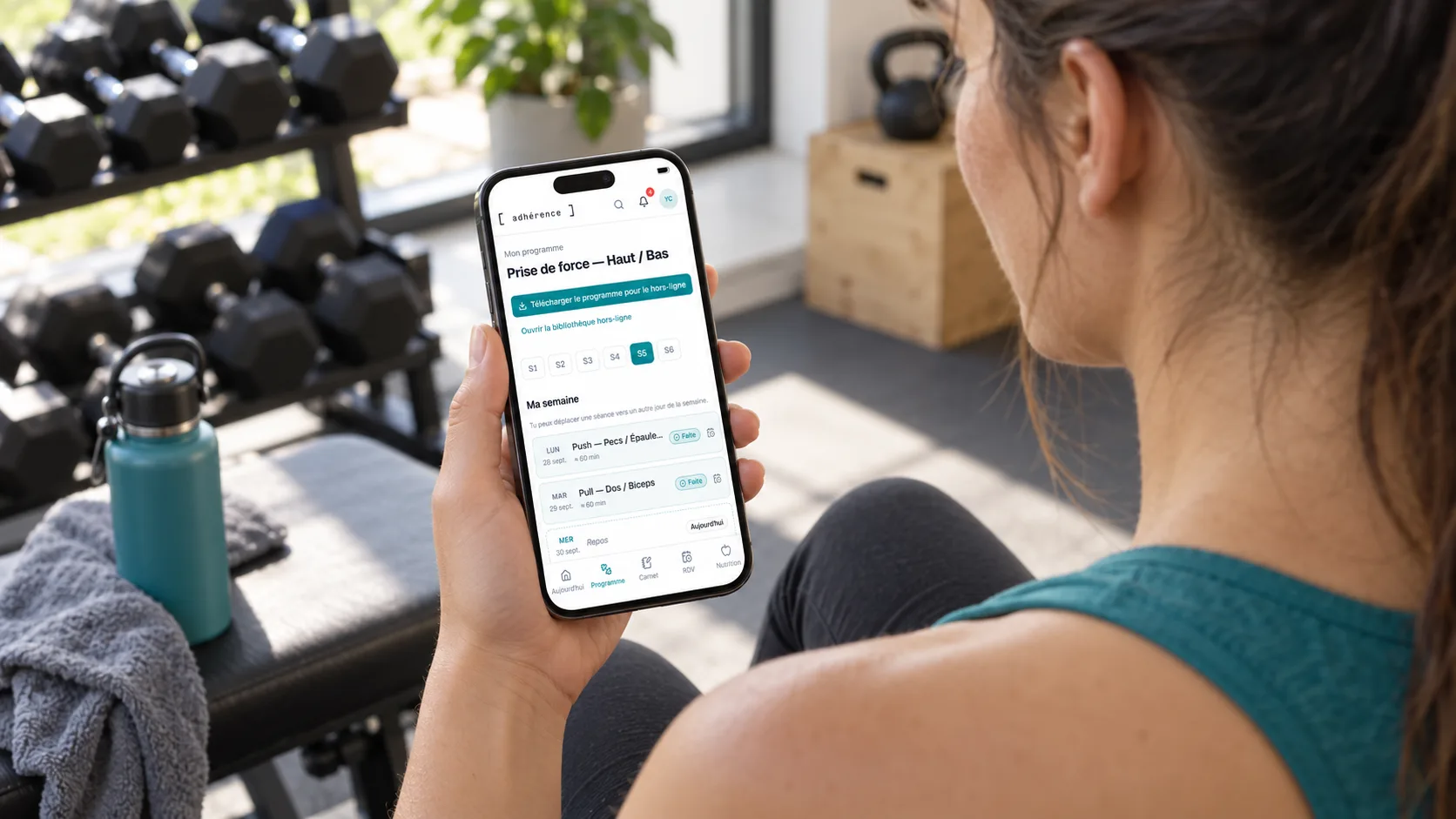
In Adhérence, the program is assigned to the client and workouts have a recording journey. Entered information is attached to the relevant training. The trainer has an adherence view to guide the review rather than beginning exclusively with conversations.
That structure serves a professional question: “What do we know about this client’s week, and what needs clarification?” It does not replace discussion about fatigue, constraints or motivation. The records provide a starting point for a more precise exchange.
See the Adhérence tracking overview for the current scope. Do not assume that coaching software replaces every WhatsApp use, including calls or established personal conversations. The useful change is giving training records a clear home.
Which criteria should a trainer compare?
Compare tasks rather than how many messages you can send. An accessible channel can still require significant work if preparing the next program starts with a lengthy search through message history.
- Need
- Quick question
- Conversation familiar to many clients
- Adhérence
- Tracking can remain paired with a conversation channel
- Need
- Active program
- Document or instructions to retrieve in exchanges
- Adhérence
- Assigned program in the client space
- Need
- Workout data
- Format to agree on and interpret
- Adhérence
- Recording connected to the workout
- Need
- Adherence overview
- Summary to maintain separately
- Adhérence
- Trainer view based on recorded tracking
- Need
- Retrieve context
- Search through the conversation
- Adhérence
- Consult the program and tracking records
- Need
- Setup
- Few new habits if the client already uses it
- Adhérence
- Invitation and learning the workout journey
| Need | Adhérence | |
|---|---|---|
| Quick question | Conversation familiar to many clients | Tracking can remain paired with a conversation channel |
| Active program | Document or instructions to retrieve in exchanges | Assigned program in the client space |
| Workout data | Format to agree on and interpret | Recording connected to the workout |
| Adherence overview | Summary to maintain separately | Trainer view based on recorded tracking |
| Retrieve context | Search through the conversation | Consult the program and tracking records |
| Setup | Few new habits if the client already uses it | Invitation and learning the workout journey |
The comparison does not rank these products for every purpose. It explains why messaging and coaching software can play complementary roles. Adhérence’s contribution is structured tracking; WhatsApp’s contribution is accessible conversation. The right division depends on what your service promises and what your clients can use consistently.
Can you identify who needs a follow-up?
A silent conversation is ambiguous. The client may train without writing, experience a disruption or be waiting for an answer. Several enthusiastic messages do not establish how many workouts they completed either.
Adhérence helps you review recorded coaching activity and adherence signals. Interpret these carefully: an unrecorded workout might have happened without being entered. Begin a follow-up with a question rather than a judgement.
For example: “I cannot see any recorded workouts this week. Did you manage to train, or should we revisit the schedule?” The client-tracking metrics guide explains this distinction between observation and interpretation. Also check whether the client understands the recording routine before interpreting repeated gaps.
How can you remain personal without constant availability?
Define response timing and where each type of information belongs. Clients should know where to record workouts, when to send feedback and how to report a difficulty. Clear organisation helps avoid treating every message as urgent.
You can offer a weekly review and use occasional exchanges for useful clarification. Explain the difference between a program adjustment and an immediate answer during training. Your commitments should match the service you actually sell.
The weekly client check-in guide provides questions for structuring that review. Software does not set your boundaries for you; it helps make the method consistent with the information collected. Review these expectations with clients when you introduce a new tool.
What about privacy?
WhatsApp states that personal messages are end-to-end encrypted. It would be incorrect to suggest that messaging inherently lacks protection. Choosing a tool calls for more precise questions.
For your own operations, check recipients, groups and the information you request. Avoid turning a shared group into an individual client record. In every system, share only information needed for the relevant coaching relationship.
Adhérence provides an individual space within that relationship. This structure does not justify claiming overall security superiority or collecting more data. This comparison addresses service organisation rather than legal certification of either product. Evaluate the configuration and information involved in your own workflow.
How can you move programs out of WhatsApp gradually?
Make the change understandable. Give clients a short rule: “Your program and workout records now belong in this space; our conversation channel keeps its agreed role.” Avoid maintaining two places to record the same workout.
- Choose the next cycle. Transfer the useful program rather than the entire conversation history.
- Prepare the workouts. Check exercises and instructions before inviting clients.
- Test with a few clients. Help them through their first recording.
- Clarify feedback. Explain what belongs in tracking and which exchanges remain useful.
- Observe your review. Check that you understand the week without re-entering messages.
This process does not assume automatic conversation import. It organises new information from an agreed date. For programs sent as files, see the Google Drive vs Adhérence comparison. Keep relevant older records accessible while you verify the new routine.
Which costs and effort should you expect?
Compare the cost of a suitable plan, the time needed to learn it and ongoing tracking work. Adhérence lets you start without a credit card with up to five clients on Free; the current pricing page describes additional capabilities.
The value of the change depends on usage. During the trial, observe repeated searches, access questions and the quality of incoming information. No application automatically saves time if clients continue recording workouts elsewhere. Include onboarding time in the assessment rather than judging only an established week after everyone has learned the system.
Frequently asked questions
Must I stop using WhatsApp completely?
No. You can keep it for conversation and move programs and workout recording to Adhérence. Explaining each space’s role matters more than eliminating every existing channel.
Is a WhatsApp group enough to follow several clients?
It can support a shared community. For individual coaching, check where programs live and how you retrieve feedback without exposing other participants’ information. Group engagement and individual adherence answer different questions.
Does Adhérence answer clients for me?
Structured tracking does not replace your judgement or client relationship. You remain responsible for the adjustments and exchanges included in your coaching service.
- Does each client know where the active program is?
- Are results connected to the correct workout?
- Have I distinguished silence, missing data and an uncompleted workout?
- Is response timing part of the stated expectations?
- Does individual information stay in the appropriate space?
- Does the trial reduce observed searching and re-entry?
Key takeaways
- WhatsApp makes client conversation accessible.
- Adhérence structures programs, recorded workouts and adherence.
- Give each channel a clear role and interpret information with its context.
- Start with upcoming workouts rather than migrating the entire message history.
Sources
- WhatsApp Messaging · WhatsApp
- WhatsApp privacy questions · WhatsApp
- Personal training software: programs and client tracking · Adhérence
Keep reading
Two related guides for turning an observation into a sustainable tracking method.