Habit tracking for personal trainers: how should you organise client goals?
Choose a useful habit, understand recorded days and prepare a review using actual Adhérence screens.
Short answer
To organise habit tracking as a personal trainer, agree one useful behaviour, an understandable measure and a review cadence with the client. Distinguish missing entries, unmet targets and a period still in progress. In Adhérence, habits complement workouts and check-ins; prescribing client habits requires Pro or the coach trial.
Habit tracking for personal trainers starts with a practical question: which observation will help the next conversation with this client? Adding steps, water, sleep and cardio to every record does not automatically improve coaching. Choose a relevant behaviour, a simple way to record it and a review point. In Adhérence, daily goals complement workouts and check-ins; each has a different role in client follow-up.
Which habit should you choose with a client?
Start with a difficulty discussed during the initial consultation. A client might want to organise walking opportunities, prepare equipment or record an agreed routine. Ask what they want to track and what they can realistically enter. The observation should support your conversation, with a purpose both people understand.
Starting with one habit is a suggested approach, not a universal rule. It helps you check whether the label is clear and recording fits the client’s day. If the information is never reviewed, or the client cannot explain its purpose, simplify before adding another goal. Stay within your qualifications: an application does not turn a coaching goal into a medical prescription.
Define the question before the number. Ask what decision you could discuss once the information is recorded. Values in the captures are fictional examples, not health targets that should be applied to every client.
How does habit tracking work in Adhérence?
From a client’s record, the coach can use steps, water, sleep or cardio presets, or define a custom label. A habit can use a numeric value with a target and comparison direction, or a yes/no response. Its frequency distinguishes a daily habit from a goal intended for a number of days per week.
The card below shows a target, recorded days and a weekly view from a demonstration account. A single day’s value and consistency over a period answer different questions. One target can be met while other days still have no information. Read the states and period before drawing a conclusion, and check that the client understands how their entries will be used.

Creating, editing and copying habits prescribed to clients requires Pro or the coach trial. Check the Adhérence plans for the relevant features. The Free coaching plan and a coach’s own personal tracking should not be confused with permission to prescribe client habits.
How do you distinguish missing entries from an unmet target?
A missing entry initially means that nothing was recorded. It does not prove that the activity did not happen or that the client has disengaged. A recorded “no” means something different: the client entered information, even though the goal was not completed. That distinction changes your first question.
In Adhérence, the current day should not be interpreted as a finished day. Some earlier days can still be entered within the available backfill window. An in-progress state therefore calls for checking the period and recording process before sending a reminder. This journey uses manual entry; it does not promise automatic synchronisation with a watch or a health application.
At review time, first ask whether the entries reflect the week. When several days are missing, check access, field meaning and the moment chosen for recording. Discuss the behaviour itself after resolving those questions. A recording problem should not automatically become an interpretation about the client’s commitment.
What weekly review routine can you use?
Agree a manageable review cadence. Check the active habit, the period and available entries, then connect observations with workouts and the client’s explanation. The client-tracking metrics guide provides a broader method: use information to decide what needs attention, rather than to rank clients against each other.
- Observation
- Several days without entries
- Check first
- Access and understanding
- Possible question
- When would recording be easy?
- Observation
- Recorded days with unmet targets
- Check first
- Feasibility in the actual context
- Possible question
- Which obstacle keeps returning?
- Observation
- A period still in progress
- Check first
- Remaining days and backfill availability
- Possible question
- Is there enough information to review the week?
- Observation
- A target regularly met
- Check first
- Whether the measure remains useful
- Possible question
- Does this habit still support your goal?
| Observation | Check first | Possible question |
|---|---|---|
| Several days without entries | Access and understanding | When would recording be easy? |
| Recorded days with unmet targets | Feasibility in the actual context | Which obstacle keeps returning? |
| A period still in progress | Remaining days and backfill availability | Is there enough information to review the week? |
| A target regularly met | Whether the measure remains useful | Does this habit still support your goal? |
Finish with an explicit decision: keep the target, clarify recording, discuss an adjustment or arrange another conversation. Avoid changing every habit and the training programme at once. A shared priority will be easier to understand during the next check-in, particularly when the client needs to explain what changed.
How can you adjust or copy habits without confusing the history?
Explain why you are changing a target and check when the revision becomes effective. In Adhérence, revisions after the creation day take effect the following day; they do not retrospectively reassess earlier entries. The interface’s effective state remains the reference for which rule applies. A new target should not make an earlier result appear to have changed meaning.
“Apply to other clients” reuses a configuration, which you then review for each person. It adds missing habits while leaving existing habits with the same preset or name unchanged. Selecting several people does not establish that an identical goal suits all of them. Review the targets, frequencies and each client’s agreement after the copy.
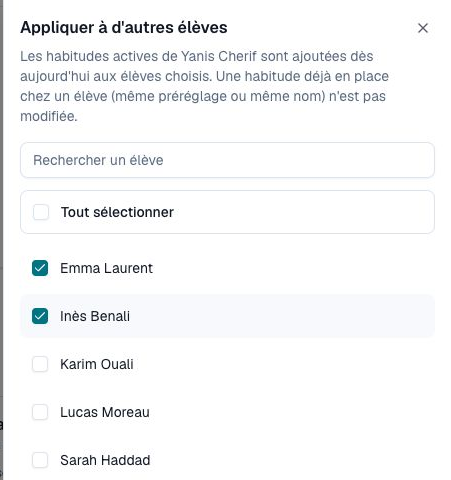
Fictional example: test a routine before extending it
Imagine a client who wants a more consistent agreed routine. The coach chooses a yes/no habit with them, explains what each response means and schedules a conversation after a week. This is one possible coaching process, with no promised outcome or fixed number of days needed to establish a habit.
At review time, two days are recorded and others are empty. The coach does not immediately decide that the routine failed. The client explains that recording is easily forgotten on travel days. They choose a more practical entry moment, temporarily keep the target and agree the next review. The decision addresses an identified friction instead of treating one score as a complete explanation.
Which information should you actually keep?
The French data-protection authority explains purpose limitation and data minimisation. Explain why each measure is useful and limit collection to the agreed follow-up. Do not request personal details simply because a field is available.
Habits in the application belong to the relevant coach–client relationship. That structure does not remove the coach’s responsibility to explain the process or recognise situations beyond their qualifications. This guide concerns organising coaching information, not diagnosing a condition or promising a health improvement. Decide in advance how questions requiring a different professional will be handled.
- Does the client understand why the habit was chosen?
- Are the measurement and frequency practical to record?
- Have I distinguished an absent entry from an unmet goal?
- Is the period sufficiently recorded to interpret?
- Does an adjustment have an understood effective date?
- Have copied settings been checked for each client?
- Does the next conversation end with a clear decision?
Frequently asked questions
Does habit tracking replace the weekly check-in?
No. Habits provide daily observations; the check-in provides context and supports the coach’s decision. Connect them without asking clients to copy all their data into a second form.
Are steps and sleep imported automatically?
The journey described here uses manual entry in Adhérence. A watch or third-party application should not be described as synchronised unless an actual integration is available.
Can you try habits before subscribing?
Coach registration starts a 14-day trial without a credit card. Prescribing client habits requires Pro or the trial; Free then supports getting started with up to 5 clients within its own feature scope.
Key takeaways
- Choose a habit that informs a concrete coaching decision.
- Distinguish the entered value, consistency and context before acting.
- Check effective dates and copied settings for each client.
- Test one routine in Adhérence before extending it to your roster.
Sources
- The six core GDPR principles · CNIL
- Personal training software: programmes and client tracking · Adhérence
- Adhérence plans and features · Adhérence
Keep reading
Two related guides for turning an observation into a sustainable tracking method.