Personal trainer: how to follow up on an overdue client payment
Verify receipts, adapt three reminder messages and keep a clear routine for outstanding coaching payments.
Short answer
Before chasing an overdue coaching payment, check receipt, the agreed amount and the deadline. Send a private message identifying the outstanding payment and asking for a clear reply. Distinguish a reported transfer from money received, then adapt the next contact to the client’s response.
A client keeps completing workouts, but their coaching payment remains outstanding. You check your bank account, search a conversation and postpone the reminder because you do not want to damage the relationship. For an independent personal trainer, late payments quickly become an organisational problem as well as a cash flow concern. A useful process tells you what is due, what has arrived and which conversation needs your attention.
This guide covers everyday payment tracking, a friendly reminder process and three adaptable message templates. A disputed contract or formal debt recovery requires separate handling and appropriate professional advice. The examples below describe fictional clients and are not legal notices.
What should a personal trainer check before chasing an overdue payment?
First, reconcile the expected payment with money actually received. A bank transfer may use a reference that differs from the client’s name. Cash received after a session may not yet appear in your records. A client saying they have paid is useful information, but it still needs confirmation.
Next, check the agreed amount, the service period and the deadline you communicated. If the payment date was unclear, begin by clarifying the agreement. An overlooked deadline and a misunderstanding about how a session pack works require different conversations.
Finally, read the most recent exchange. Has the client mentioned a difficulty, requested a pause or promised a transfer? Your reminder should acknowledge that context. Record what you checked so that the next administrative review does not begin with the same search through messages and bank transactions.
An overdue status describes a missed date. It does not explain why the payment is missing. The first reminder should establish the facts and the next step without assuming that the client is acting in bad faith.
How can you organise client payment tracking?
Keep one reference list instead of relying on memory, screenshots and scattered conversations. Each entry should represent an identifiable amount due, such as October coaching or a particular session pack. If one transfer covers several items, retain an explanation that makes sense to both you and your client.
The useful fields are straightforward: client, service, amount, expected date, status and last action. A next review date belongs to your working method. Do not assume that your chosen coaching software offers a dedicated task field or a configurable reminder schedule unless you have checked it.
- Information
- Amount and service
- Question to resolve
- Does the client know what the request covers?
- Possible action
- Name the period or session pack
- Information
- Deadline
- Question to resolve
- Was the date communicated?
- Possible action
- Clarify before calling it overdue
- Information
- Payment reported
- Question to resolve
- Has receipt been confirmed?
- Possible action
- Check the account or cash record
- Information
- Last conversation
- Question to resolve
- Has a difficulty been mentioned?
- Possible action
- Adapt the reminder to the context
- Information
- Current status
- Question to resolve
- Is the amount still outstanding?
- Possible action
- Follow up or close the record
| Information | Question to resolve | Possible action |
|---|---|---|
| Amount and service | Does the client know what the request covers? | Name the period or session pack |
| Deadline | Was the date communicated? | Clarify before calling it overdue |
| Payment reported | Has receipt been confirmed? | Check the account or cash record |
| Last conversation | Has a difficulty been mentioned? | Adapt the reminder to the context |
| Current status | Is the amount still outstanding? | Follow up or close the record |
Keep this review distinct from training progress. An unpaid amount does not automatically explain reduced attendance, and a missed workout does not demonstrate financial difficulty. The client tracking indicators guide explains how to interpret these signals separately before making a decision about the coaching relationship.
What should the first friendly payment reminder say?
A useful message identifies the payment, recalls the date and makes replying easy. Avoid a vague request such as “can you sort this out?” because it forces the client to reconstruct the context. Here is a fictional example to adapt after checking your records.
Hi Alex, I’m reviewing coaching payments. The €120 payment for October coaching, due on 5 October, is still showing as outstanding in my records. Could you confirm whether you have already sent it? If not, could you let me know when you expect to pay? Thank you!
The amount and date are examples, not recommended pricing or standard contract terms. Replace them with the actual agreement. If you include payment instructions, use the method already communicated to your client and double-check the recipient details before sending anything.
Use a familiar, private channel. A payment reminder should not appear in a group conversation or be visible to another client. The CNIL’s core data protection principles include minimisation: collect and share only the information needed for the purpose. A short operational message rarely requires a detailed personal explanation.
What if the client says they have already paid?
Acknowledge their reply and check receipt. “Payment reported” and “payment received” are different states. You can ask for the transfer date and reference without requesting a full bank statement or unrelated financial information.
Thanks for letting me know. I’ll check that the payment has arrived. Could you tell me the transfer date and the reference you used? I’ll update the record once I find it. There’s no need to send your full bank statement.
If you locate the payment, close the outstanding item and briefly confirm the update. If you cannot find it, explain what you checked and agree on another review. Sending the identical reminder immediately after their reply makes the process feel disconnected from the actual conversation.
Apply the same discipline to cash. Check your own record, then mark the payment as received when appropriate. The purpose is to avoid requesting payment twice and maintain a reliable administrative view even when the money changes hands outside the coaching application.
How can you send a second reminder without damaging trust?
Refer to the previous exchange and make the next request more specific. After several unanswered messages, a direct conversation may be more useful than another notification. The timing should fit the original agreement and the circumstances you know about.
Hi Alex, I’m following up on the October coaching payment, which is still outstanding after my check. Could you reply by Thursday to confirm the expected payment date or let me know if there is a difficulty? We can then clarify the next steps for your coaching together.
The response date is an example, not a legal rule. If the client mentions a problem, write down what has been proposed and what still needs agreement. Any revised arrangement should identify the amount, dates and agreed consequences rather than introduce a different condition in every conversation.
In a fictional case, Sarah says on Monday that she will send a transfer. Her coach plans to check receipt on Thursday. The coach does not mark the amount as paid on Monday or send repeated messages in between. Separating a promise from confirmed receipt makes the next action clear.

What payment tasks can Adhérence centralise?
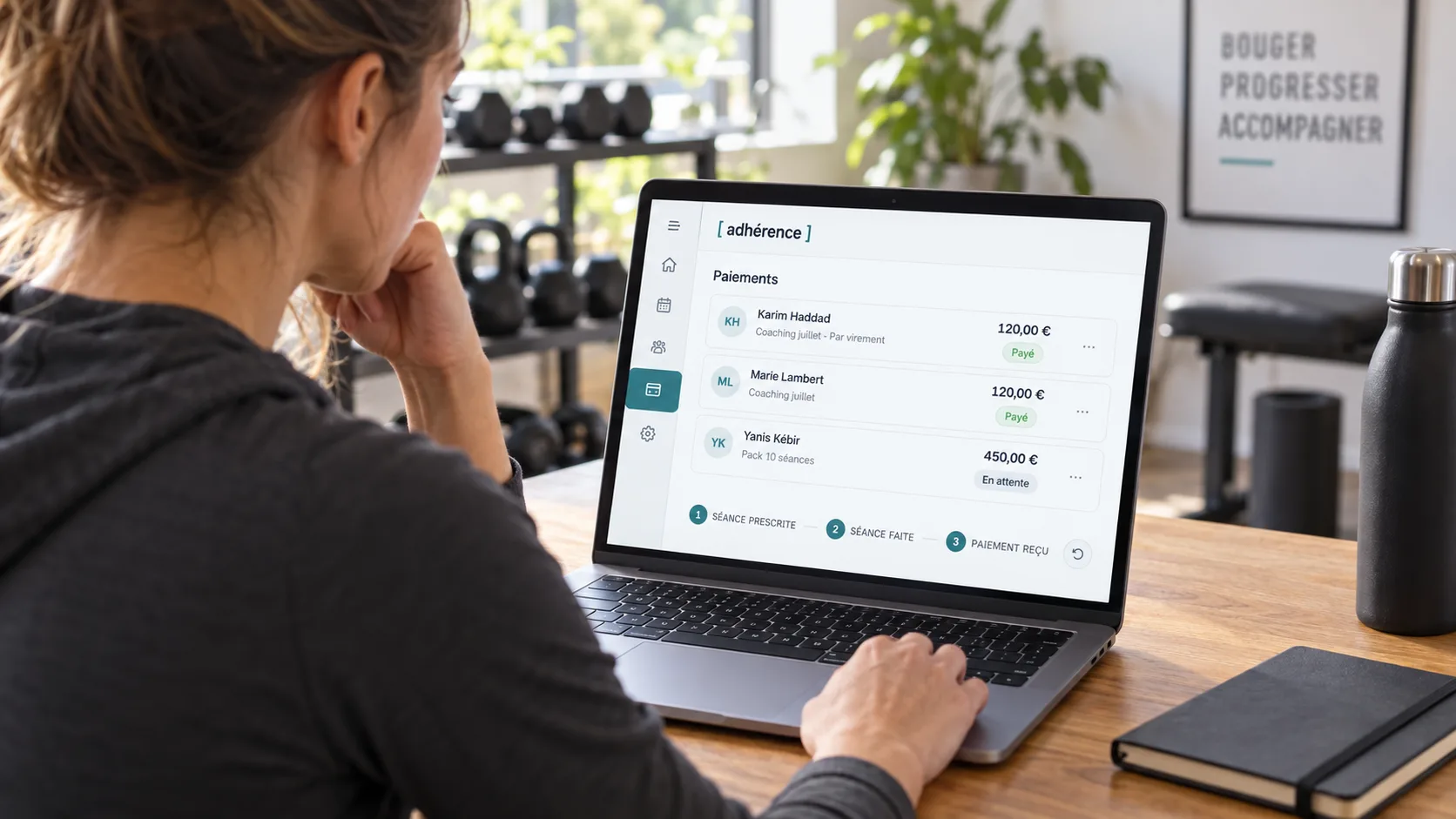
The Business plan supports amounts due, deadlines and payment statuses, with reminders for outstanding payments. For bank transfers and cash, the coach confirms receipt. The application organises tracking; it does not itself move those funds between the client and the coach.
Card payments depend on beta activation for the relevant account. Stripe Checkout documentation describes Stripe’s hosted payment experience; it does not mean every Adhérence account has this option enabled. Check the current pricing page for the applicable availability and conditions before promising a payment method to a client.
For session packs split into two payments, the second instalment is not automatically debited. An optional restriction on prescribed workouts depends on the pack’s own setting and threshold. Explain that arrangement before it affects the client; it does not replace a conversation or payment reconciliation.
This connects administrative follow-up with the coaching relationship while keeping payment tracking, invoicing and accounting distinct. For the wider workflow, explore the personal trainer software page and the guide to setting coaching prices.
What routine helps prevent forgotten payments?
Choose a regular administrative review and focus on outstanding items that need action. Set expectations during onboarding: explain the price, service period, due dates and payment method before a first reminder becomes necessary. A clear starting agreement saves repeated explanations later.
- Reconcile received payments before sending a reminder.
- Identify the service, amount and agreed deadline.
- Read the client’s latest response before contacting them again.
- Send a private message with a specific request.
- Record the agreement and your next verification step.
- Update the payment status after confirming receipt.
Frequently asked questions about overdue coaching payments
Should you remind a client the day after a deadline?
First check payments received and the terms you communicated. A reminder near the due date may be appropriate, but the latest conversation matters more than mechanically applying a calendar to every situation.
Does a transfer screenshot count as receipt?
It can help you locate a transaction. For your records, distinguish that information from the money arriving in your account. Confirm the update with the client once you have verified receipt.
Does coaching software replace accounting software?
Outstanding payment tracking and reminders serve an operational purpose. On their own, they do not replace invoicing, accounting obligations or the tools and professional support needed to handle a formal dispute.
Key takeaways
Before chasing a late coaching payment, verify the facts, identify the amount clearly and ask for a concrete reply. Centralised tracking helps when statuses stay current. A constructive relationship also depends on a clear initial agreement and reading the client’s circumstances before taking the next step.
Sources
- Stripe Checkout: hosted payment experience · Stripe Documentation
- The six core GDPR principles · CNIL
- Adhérence plans and features · Adhérence
Keep reading
Two related guides for turning an observation into a sustainable tracking method.